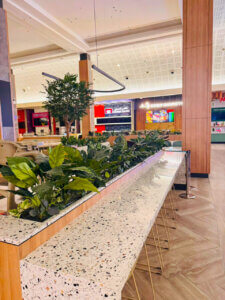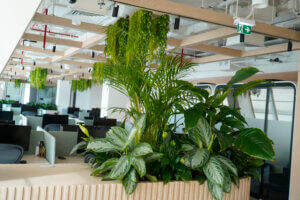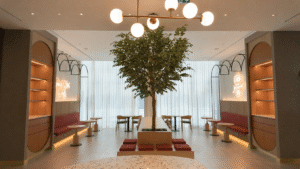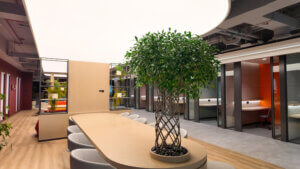
The difference between a landscaping installation that looks exactly as designed and one that falls short is rarely the quality of the contractor. It is usually the quality of the brief.
Indoor landscaping for commercial fit-outs in the UAE involves a set of technical, spatial, and operational decisions that cannot be resolved on site at the point of installation. The choices that determine how an installation performs — species selection, planter sizing, light requirements, irrigation approach, maintenance access — all need to be made before a single plant is ordered. And they need to be made with accurate information about the project.
This is a practical guide to what a landscaping contractor needs from you at the briefing stage, and why each element matters.
1. A Dimensioned Floor Plan With Zone Annotations
The starting point for any landscape brief is a current, dimensioned floor plan — not a concept sketch, but an accurate representation of the space as it will be built. On this plan, the landscape zones need to be clearly identified: where planting is intended, at what scale, and what spatial function it is serving (feature, boundary, threshold, acoustic treatment, decorative fill).
Zone annotations should also indicate adjacency to other elements — reception desks, seating clusters, circulation routes, column positions — that will affect planter placement and scale. A contractor working from an undimensioned or outdated plan will make assumptions. Some of those assumptions will be wrong, and correcting them after product has been ordered is expensive.
2. Confirmed Light Level Data
Light is the single most important environmental factor for live plant selection and placement. A landscaping brief that specifies live plants without confirmed light level data is setting up a problem for post-installation.
What the contractor needs:
- The orientation of the space and any glazed facades (north, south, east, west)
- Whether natural light reaches the landscape zones, and at what hours
- Whether supplementary grow lighting is included in the MEP design, and at what lux levels
- Any zones that are entirely below ground or artificially lit
With this information, a specialist contractor can recommend species that will genuinely thrive in each zone, and flag zones where live planting is not practical — avoiding the post-handover situation where plants decline because the light conditions were never adequate to support them.
3. Structural and MEP Information for Planting Zones
Several elements of a landscaping installation interact directly with the structural and MEP design of the building. These need to be resolved at brief stage, not during installation:
- Floor loading capacity in zones where large planters or planted walls are proposed — mature specimen trees and large planters can be significantly heavy when planted and watered
- Drainage provision — whether planters will drain to waste, use self-contained reservoir systems, or require waterproofed bases
- Water supply points for irrigation systems, particularly for green walls
- Electrical supply points for grow lighting or automated irrigation control
For green walls specifically, the MEP requirements are substantial enough that they need to be incorporated into the building services design — not resolved as an afterthought. A landscaping contractor engaged early enough can provide the technical input required by the MEP consultant.
4. Design Intent and Material Palette
The brief should communicate the design intent clearly enough for the contractor to make species and planter recommendations that are genuinely consistent with the interior concept. This means sharing:
- The material palette — finishes, colours, textures — so that planter design can be coordinated rather than selected in isolation
- The character of the space — formal, organic, industrial, luxurious, minimal — which affects species selection as much as any technical factor
- Any reference images or precedent projects that communicate the desired aesthetic
- The brand guidelines of the end client, if planting is being used as part of brand expression
Without this context, a contractor will make safe, generic choices. With it, they can make choices that feel inevitable — as if the planting was designed for this space, not inserted into it.

5. The Post-Handover Maintenance Plan
The maintenance plan for an installation should be decided before the installation is specified, not after it is complete. This is because the maintenance approach directly affects what gets specified.
A space with a professional maintenance contract in place can accommodate high-maintenance live species — large tropical specimens, living walls, statement flowering plants — that would be inappropriate in a space where maintenance will be ad hoc or infrequent. A space without reliable maintenance access is better served by lower-maintenance live species, high-quality artificial plants, or preserved moss walls that require minimal ongoing care.
The brief should confirm:
- Whether a maintenance contract will be in place, and at what frequency
- Who will be responsible for maintenance — the landscaping contractor, an in-house team, or a facilities management company
- Any zones with restricted maintenance access that require a no-maintenance or low-maintenance specification
6. Programme and Sequencing
Landscaping is typically one of the last trades to install on a commercial fit-out programme. This creates compression at the end of the schedule that, without planning, leads to rushed installation and reduced quality. The brief should confirm:
- The target installation date and any phasing requirements
- What preceding works need to be complete before landscaping can begin (floor finishes, joinery, MEP sign-off)
- Any access restrictions — building operating hours, goods lift dimensions, floor protection requirements
- Defect liability period and snagging process
A landscaping contractor who has this information from the start can plan procurement, acclimatisation of live plants, and installation sequencing accordingly. One who receives it at short notice cannot.
Why This Matters More in the UAE
The UAE commercial fit-out market moves at a pace that compresses timelines and creates pressure to defer decisions. In this environment, the briefing stage is the point at which good project outcomes are secured or compromised. Decisions deferred from the brief to the site visit, and from the site visit to the installation, accumulate into problems that are increasingly difficult and expensive to resolve.
The projects that deliver exceptional indoor landscaping — the ones that define the standard for commercial interiors in Dubai — are not the ones with the largest budgets. They are the ones where the brief was clear, complete, and issued early enough for the contractor to respond properly.
That is within reach on every project.