Dubai’s food and beverage market is one of the most visually competitive in the world. Every new opening is photographed, reviewed, and compared against a constantly rising standard of interior quality. In this environment, the physical design of a space is not a supporting element of the F&B concept — it is part of the product itself.
Indoor landscaping has become one of the defining features of Dubai’s most successful restaurant and cafe interiors. Not as decoration, but as a spatial and experiential tool that shapes how guests feel in the space, how long they want to stay, and whether they take and share the photographs that drive the awareness and footfall the business depends on.
For interior designers working on F&B projects in the UAE, understanding how to specify indoor landscaping effectively — and what the common mistakes are — is increasingly a core part of the discipline.
Why Indoor Plants Work Particularly Well in F&B Environments
The goals of a well-designed F&B interior and the characteristics of indoor landscaping align closely. Plants introduce visual complexity and warmth into spaces that are often built from hard, reflective surfaces. They create intimacy within larger rooms by breaking sightlines and defining sub-spaces. They provide acoustic absorption that reduces the perceived noise level in busy restaurants — a practical benefit that is often undervalued at the specification stage. And they photograph exceptionally well, which in Dubai’s social media-driven F&B culture is not a trivial consideration.
There is also an emotional dimension. Environments with living plants are consistently rated as more comfortable, more relaxing, and more enjoyable than equivalent spaces without. For a restaurant or cafe whose success depends on guests wanting to linger, that emotional comfort translates directly into dwell time, and dwell time translates into spend.
Spatial Applications That Work in Dubai F&B Interiors
The Green Wall as the Hero Feature
A planted or moss wall feature is the most commonly specified indoor landscape element in Dubai restaurant interiors, and for good reason: it creates an immediate visual impact that is legible from anywhere in the space, it serves as a backdrop for photographs that guests want to take and share, and it contributes to the acoustic quality of the room.
For F&B applications, the choice between a live planted wall and a preserved moss wall is significant. A live wall requires irrigation infrastructure and professional maintenance — it will look exceptional if properly managed and decline quickly if it is not. A preserved moss wall requires no irrigation and minimal maintenance, is available in a wide range of colours and textures, and performs consistently over time. For operators without a clear maintenance plan in place, the moss wall is often the more reliable choice.
Zone Definition With Planting
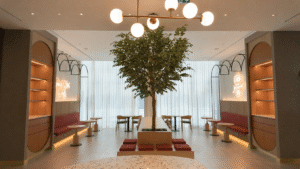
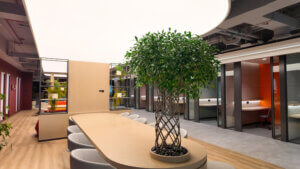
Large Dubai restaurants often struggle with a spatial challenge: the space is open and connected, which is commercially efficient, but it lacks the intimacy that makes dining feel like an event. Indoor planting — planter clusters, planted dividers, specimen trees in feature planters — can create sub-zones within a large open space that feel distinct and private without requiring walls.
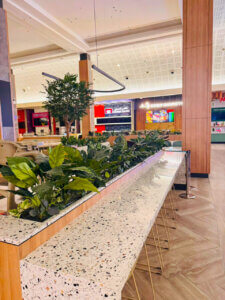
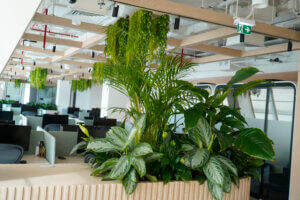
A cluster of tall Kentia palms in substantial planters between a bar and a dining area creates a visual and spatial boundary that separates the two zones while maintaining connectivity. The effect is immediately legible to guests — they feel they have arrived somewhere specific, rather than sitting in a large undifferentiated room.

Table and Surface Planting
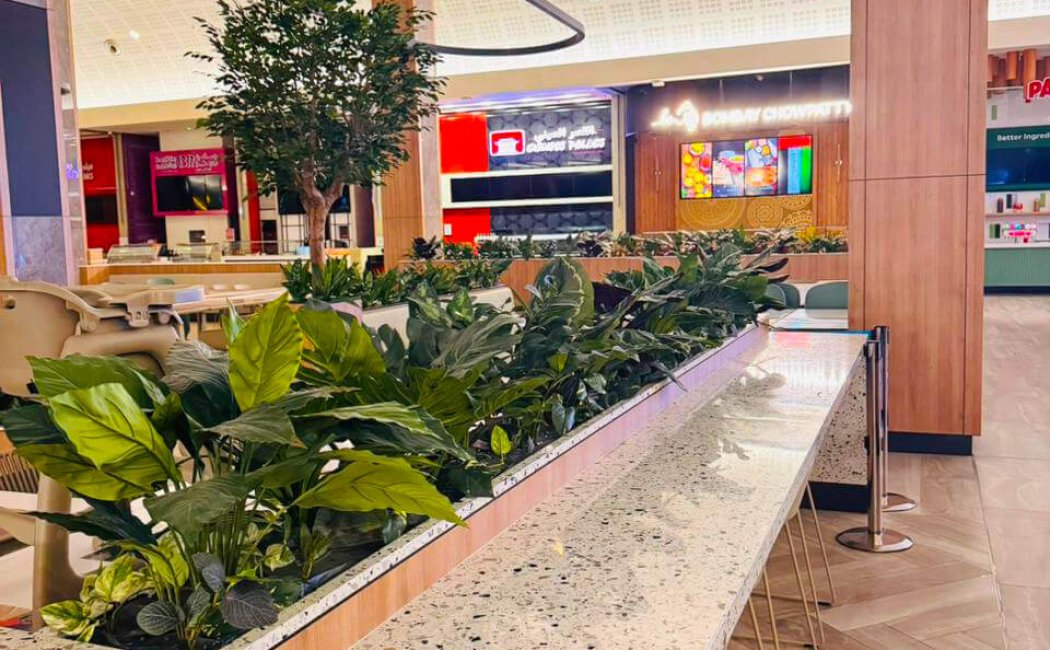
Smaller-scale planting at table level — planted centrepieces, low planter arrangements on banquette ledges, trailing plants above booth seating — adds organic texture and warmth at the scale that guests experience most directly. This approach works well in smaller F&B concepts where a large green wall installation is not feasible, or as a complement to a feature wall in larger spaces.
In Dubai’s cafe culture particularly, this kind of intimate, tactile planting is part of the aesthetic language that guests expect in premium independent concepts. The quality of the plant selection and the planter design at this scale matters — a generic plastic pot on a restaurant table reads as an afterthought regardless of how well the rest of the interior is designed.
Specification Considerations Specific to F&B
F&B environments present specific challenges that need to be addressed at the specification stage.
Maintenance Access in an Operational Space
A restaurant in operation cannot easily accommodate maintenance visits during service hours. Maintenance access needs to be planned for — what times are available, how does the maintenance team access the space without disrupting operations, who is the point of contact. For complex live installations in busy F&B environments, weekly maintenance visits outside service hours are typically necessary and need to be factored into the programme from the beginning.
Humidity and Steam in Kitchen-Adjacent Zones
Zones near open kitchens or food preparation areas may have elevated humidity and temperature variation from cooking activity. Some species perform better in these conditions; others are compromised by the additional stress. The specification should account for the microenvironment of each zone, not just the general interior conditions.
The Visual Consistency Requirement
In a restaurant context, the plants need to look excellent every day — not most days. A plant that is visibly struggling during service affects the guest experience and the quality of photographs taken in the space. The maintenance programme needs to deliver consistent results, which means the visit frequency and the proactive management of plant health needs to be calibrated to the standard the F&B environment demands.
Live vs. Artificial in F&B: The Practical Reality
The instinct in premium F&B design is to specify live plants — they are more authentic, more sensory, and more aligned with the quality positioning of most Dubai restaurant concepts. This is the right instinct, where the conditions and the maintenance programme support it.
Where conditions are challenging — low light levels in basement or windowless concepts, restricted maintenance access, or operator preference to avoid the ongoing complexity of live plant care — high-quality artificial plants offer a practical alternative that, in the right application and at the right specification level, is visually convincing and operationally straightforward.
The hybrid approach — live plants as feature elements in prime positions with good light and maintenance access, high-quality artificial or preserved moss installations in secondary zones — is increasingly the approach taken in Dubai’s most considered F&B interiors. It delivers the authentic quality of live planting where it matters most while managing the operational complexity of a fully live installation.
Briefing the Landscaping Contractor
For interior designers working on F&B projects, engaging the landscaping contractor early — at concept design stage rather than at the end of the fit-out — consistently produces better results. The landscaping contractor can contribute to species selection based on actual light measurements, advise on irrigation infrastructure requirements before MEP design is finalised, and ensure the planter design is integrated into the interior rather than added afterwards. In Dubai’s fast-moving F&B fit-out market, early engagement is the most effective insurance against installation problems on opening day.