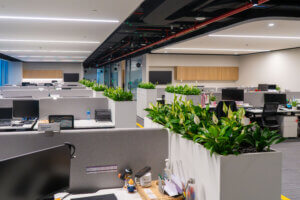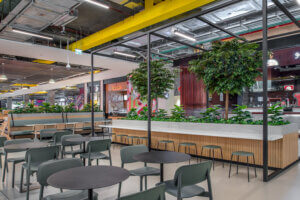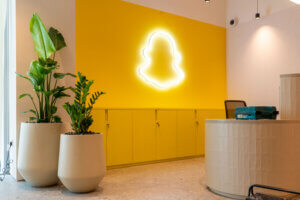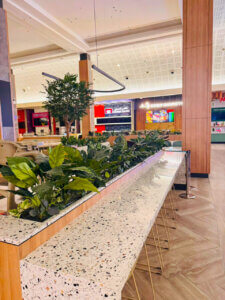
Ask most people what threatens indoor plants in the UAE and they will say heat. The actual answer, for plants installed inside commercial buildings, is more specific: air conditioning.
The UAE’s commercial building stock is almost entirely dependent on mechanical cooling. Buildings are sealed, air-conditioned continuously, and designed to maintain comfortable temperatures for occupants. For the people inside, this works well. For indoor plants, it creates a set of conditions that are consistently challenging — and in many cases, the reason a landscape that looked excellent at installation begins to decline within months.
What Air Conditioning Does to the Indoor Environment
Air conditioning systems do three things that affect plant health: they lower temperature, they circulate air mechanically, and — critically — they remove moisture from the air. In the UAE, where commercial buildings run continuous cooling for most of the year, the cumulative effect of these three factors creates an indoor environment that is drier, more temperature-variable, and more artificially ventilated than most tropical and subtropical plant species are adapted to tolerate without support.
Low Relative Humidity
This is the single biggest challenge for indoor plants in UAE commercial buildings. Air conditioning removes moisture as part of the cooling process, and in a well-sealed commercial building running at full capacity, relative humidity can drop to levels well below what most indoor plant species prefer. Many of the tropical species commonly used in commercial interiors — Ficus, Dracaena, Spathiphyllum, Monstera, Calathea — evolved in environments with relative humidity between 60 and 80 percent. UAE commercial interiors during summer can drop to 30 to 40 percent or lower.
The visible effect is leaf tip browning, curling leaf edges, and accelerated leaf drop. The less visible effect is increased transpiration stress — plants losing moisture through their leaves faster than they can absorb it through their roots, which weakens them over time and makes them more vulnerable to secondary problems.
Cold Air Blast Stress
Plants positioned directly beneath or near air conditioning outlets are exposed to intermittent cold air blasts that can cause localised temperature stress. Cold air directed at leaves causes cellular damage that presents as brown or blackened patches, wilting in the area of exposure, and asymmetric decline — one side of a plant declining while the other remains healthy.
This is a placement problem, but it is also a monitoring problem. Cold air exposure damage can develop gradually and is easy to miss until it is significant.
Disrupted Stomatal Function
Plants regulate moisture and gas exchange through tiny pores in their leaves called stomata. In low-humidity environments with strong air circulation, stomata can become stressed — the plant either keeps them closed to conserve moisture (which limits photosynthesis) or keeps them open (which accelerates water loss). Either response weakens the plant over time.

Species That Are Most Vulnerable
Not all indoor plants respond to low humidity and AC environments equally. The species most commonly showing decline in UAE commercial interiors due to AC-related stress include:
- Calathea species — among the most humidity-sensitive, frequently specified for their decorative foliage, frequently declining in dry commercial environments
- Ferns — exceptionally sensitive to low humidity; rarely perform well in fully air-conditioned UAE commercial spaces without active intervention
- Peace Lily (Spathiphyllum) — performs well in many conditions but shows tip browning quickly in low humidity
- Fiddle Leaf Fig (Ficus lyrata) — sensitive to both cold air blasts and low humidity; prone to leaf drop when stressed
- Orchids — popular in hospitality settings, highly sensitive to temperature variation and low humidity
A professional installation specifies species based on the actual conditions of the space. If the environmental assessment shows a fully air-conditioned, low-humidity interior, the species selection should reflect that — choosing more resilient species or incorporating humidity management into the care programme.
What Professional Maintenance Does to Manage This
Knowing that AC environments create specific risks, a professional maintenance programme for UAE commercial interiors incorporates targeted interventions that address these conditions:
- Humidity monitoring — regular measurement of relative humidity in key plant zones to identify when intervention is needed
- Placement assessment — identifying and repositioning plants that are in direct AC blast zones
- Adjusted watering — increasing moisture delivery frequency in very low humidity environments to compensate for accelerated transpiration
- Leaf cleaning — removing dust that accumulates faster in high air-circulation environments and that compounds the effect of low humidity on transpiration
- Misting programmes for humidity-sensitive species in appropriate settings
- Early identification of AC-related stress symptoms — tip browning, leaf curl, asymmetric decline — before they become irreversible
A maintenance team that understands AC-related plant stress looks for different things during a visit than one simply checking that plants are watered. The specific diagnostic skills required are part of what distinguishes specialist indoor commercial maintenance from general horticultural care.
Preventing the Problem at Specification Stage
The most effective management of AC-related plant decline is to account for it before the installation is completed. Species selection, placement planning, and humidity management should all be addressed at the design and specification stage, not addressed reactively after plants begin to struggle.
For interior designers working on UAE commercial fit-outs, briefing the landscaping contractor on the HVAC design — the location of supply and return air outlets, the target humidity levels, the air change rate — allows the contractor to specify appropriately. A species that would perform well in a naturally ventilated space may be entirely unsuitable for a sealed, fully air-conditioned commercial interior.
When to Reconsider the Species Mix
If a commercial interior is consistently seeing AC-related decline across multiple species despite professional maintenance, it may be worth reviewing the species specification. This does not mean replacing the landscape — it means substituting the most vulnerable species with more resilient alternatives that can perform better in the specific conditions of that space.
This kind of proactive adjustment is part of what a good ongoing maintenance relationship delivers. A contractor with ongoing knowledge of a specific installation is better placed to recommend these adjustments than one seeing the space for the first time.