In commercial real estate, the factors that drive tenant retention are well understood: location, specification, service quality, and total occupancy cost. What is less discussed — and increasingly relevant in Dubai’s competitive market — is the role that the physical environment plays in how tenants experience a building day to day.
Indoor landscaping sits at the centre of that experience. And in the UAE, where commercial property developments are raising their specification standards continuously, how a building looks, feels, and functions in its common areas has a direct bearing on whether tenants stay.
The Environment Is Part of the Product
Commercial tenants in the UAE — particularly those occupying premium office space in DIFC, Business Bay, Dubai Hills, or Jumeirah Lake Towers — are not just renting square footage. They are making a statement about their business through the environment they occupy. The lobby, the common corridors, the shared amenities: all of these communicate something about the building’s standard and, by extension, the tenant’s own positioning.
When a building’s common areas are well designed and well maintained — and that includes the quality of the indoor landscaping — it reinforces the tenant’s decision to be there. When those areas are visually neglected, it creates a quiet dissonance that may not be the primary driver of a lease non-renewal, but it contributes to it.
What the Data Suggests
Research from commercial real estate markets in the US and Europe has consistently shown that built environments with integrated greenery score higher on occupant satisfaction surveys. In the UAE, where wellness-focused workplace design has accelerated significantly in the post-2020 period, this correlation is increasingly recognised by property managers and asset managers as a metric worth tracking.
The mechanism is not complicated. Tenants whose employees enjoy coming to work are more likely to renew their leases. Employees who find common areas welcoming and well-maintained spend more time in shared spaces, which improves their experience of the building. Indoor landscaping is one of the most cost-effective ways to improve that experience at scale.
The Common Area Effect
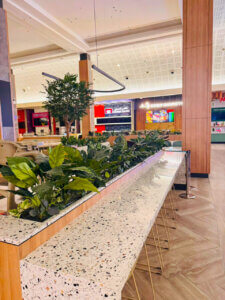
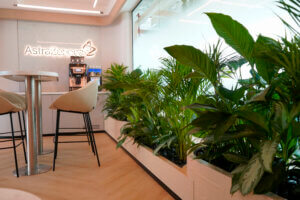
For multi-tenant commercial buildings, the impact of indoor landscaping is strongest in common areas: lobbies, lift lobbies, corridors, rooftop amenity spaces, and food and beverage facilities within the building. These are the spaces every tenant passes through daily. Their quality sets the tone for how tenants and their clients experience the building as a whole.

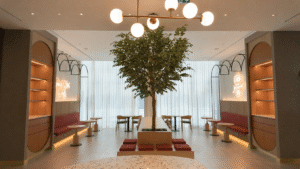
An investment in a well-designed lobby installation — a statement indoor tree, a green wall behind the reception desk, a carefully considered planter arrangement at a key transition point — delivers its return through every person who passes through the space. For a building with several hundred occupants and a constant flow of client visitors, the cumulative impression is significant.
Landlord Landscaping vs. Tenant Fit-Out Landscaping
There are two distinct layers to landscaping in commercial properties: what the landlord provides in the common areas, and what individual tenants incorporate into their own fit-outs. Both matter, but they serve different functions.
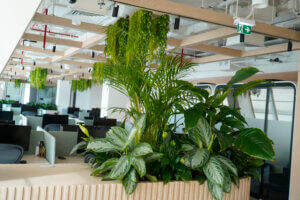
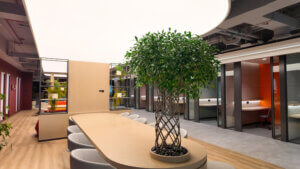
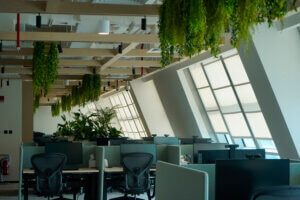
Landlord-provided landscaping in common areas sets the baseline quality of the building environment and affects all tenants equally. It signals investment in the asset and care for the occupant experience. Tenant fit-out landscaping — where a company incorporates plants, green walls, or planter features into their own office space — signals investment in employee experience and brand.
The most successful commercial buildings in Dubai are seeing both layers used deliberately. Landlords who invest in quality common area landscaping attract tenants who are more likely to invest in their own spaces, which in turn raises the overall standard of the building.
Maintenance Is the Critical Variable
The retention benefit of indoor landscaping is entirely contingent on maintenance. A lobby installation that looked exceptional at handover and has since been poorly maintained communicates the opposite of what was intended. Yellowing plants, sparse arrangements, dusty leaves, or visually inconsistent planting in shared areas communicates neglect — and in a premium commercial building, neglect is noticed immediately by tenants and their clients.
For property managers and asset managers, the lesson is that landscaping is not a one-time capital expenditure. It is a recurring operational investment. The budget for ongoing professional maintenance needs to be factored into the total cost of the landscaping programme from the outset, not added as an afterthought.
Landscaping as a Leasing Tool
Beyond retention, indoor landscaping affects the ability to attract new tenants in the first place. In a competitive market where potential tenants are comparing multiple buildings, the common area experience matters in the leasing process. A building with a genuinely impressive lobby installation — not a generic arrangement of corporate plants, but a considered, professionally executed landscape — differentiates itself during viewings.
Interior designers and fit-out consultants working with occupier clients increasingly flag the quality of a building’s base specification, including its common area landscaping, as part of the evaluation. A building that invests in this detail is signalling a standard of management that is attractive to premium tenants.
Practical Implications for Asset Managers
For those managing commercial property assets in the UAE, the actionable takeaways are straightforward. First, treat indoor landscaping in common areas as infrastructure, not decoration — it has a measurable impact on the experience of the asset. Second, budget for professional maintenance from the outset. Third, specify the landscaping as a design decision, not an afterthought — engage a specialist contractor at the design stage rather than selecting from a catalogue at the end of the fit-out.
The buildings that are consistently achieving strong tenant retention and lease renewal rates in Dubai’s commercial market are, almost without exception, buildings where the detail of the environment — including the indoor landscaping — has been taken seriously. That is not a coincidence.