Why Some Developments Feel Premium—And Others Don’t
Walk into two coastal developments in Ras Al Khaimah.
Both have modern architecture. Both overlook the same landscape. Both promise a premium experience.
But one feels… different.
It feels calmer. More inviting. More complete.
People linger longer. Take photos. Sit outside. Engage with the space.
The difference?
It’s not the building. It’s the landscaping.
In coastal developments, outdoor environments are not secondary—they define how the space is experienced. And in Ras Al Khaimah, where climate conditions are demanding, landscaping becomes both a design challenge and a strategic advantage.
The Reality of Landscaping in Ras Al Khaimah
Designing outdoor spaces in RAK is not straightforward.
Unlike temperate environments, landscaping here must perform under:
- extreme heat
- high UV exposure
- coastal wind conditions
- saline air
- water efficiency constraints
This creates a critical tension:
How do you create lush, inviting outdoor environments in a climate that naturally resists them?
At the same time, developers—especially in hospitality and residential—expect:
- visual impact
- usability
- long-term durability
- minimal maintenance disruption
This is where most landscaping fails.
The Project Challenge: Beyond Aesthetic Landscaping
In this coastal development project, the objective was not simply to “add greenery.”
It was to:
- activate outdoor spaces
- enhance guest experience
- align with sustainability goals
- maintain long-term performance
The site included:
- outdoor walkways
- shaded seating zones
- building perimeters
All exposed to the elements.
The margin for error was small.
The Strategy: Climate-Resilient Outdoor Landscaping
The approach focused on designing for survival first—and aesthetics second.
Because in the UAE, if plants don’t survive, design doesn’t matter.
1. Elevated Planter Systems for Environmental Control
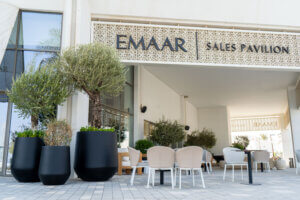
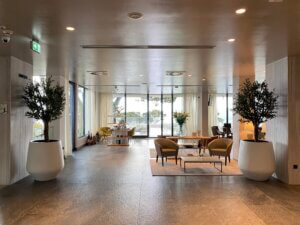
Instead of traditional ground planting, elevated planters were used.
Why?
Because they allow:
- controlled soil conditions
- better drainage
- protection from saline ground exposure
This improves plant longevity dramatically.
It also allows for consistent design across the entire space, regardless of ground conditions.
2. Layered Planting for Depth and Function
Rather than flat, decorative planting, the design used layered greenery:
- low-level plants for coverage
- mid-height plants for structure
- taller elements for visual impact and shade
This creates:
- natural cooling effects
- visual richness
- a more immersive outdoor experience
It also reduces the “empty” feel common in large outdoor developments.
3. Strategic Placement for Usability
Plants were not placed randomly.
They were positioned to:
- define pathways
- create shaded zones
- guide movement
This turns landscaping into a functional design tool, not just decoration.
The Result: Outdoor Spaces That Actually Get Used
The transformation wasn’t just visual—it was behavioral.
People started using the space differently.
Before:
- pass-through areas
- minimal interaction
- low engagement
After:
- seating zones became active
- outdoor areas felt inviting
- users spent more time outside
This is the real measure of successful landscaping.
Why Sustainable Landscaping Is Critical in RAK
Sustainability isn’t just a trend—it’s a requirement.
In Ras Al Khaimah, landscaping must:
- minimize water usage
- reduce long-term maintenance
- withstand environmental stress
Sustainable landscaping achieves this through:
- climate-adapted plant selection
- efficient irrigation strategies
- durable materials
This reduces both environmental impact and operational cost.
The Business Impact: More Than Just Aesthetic Value
For developers and operators, landscaping directly affects:
1. Guest Experience
Outdoor spaces become part of the offering—not just the backdrop.
2. Property Value
Well-designed environments increase perceived value.
3. Brand Positioning
Premium developments require premium environments.
Positioning: Landscaping as a Strategic Asset
This project reflects a larger shift happening across the UAE:
Landscaping is no longer a finishing touch—it’s part of the core development strategy.
Especially in coastal destinations like RAK, where outdoor environments define the experience.
Landscaping in Ras Al Khaimah is not about adding greenery—it’s about designing environments that work in extreme conditions while delivering premium experiences.
When done right, it transforms outdoor spaces into high-value assets that support both user experience and long-term performance.