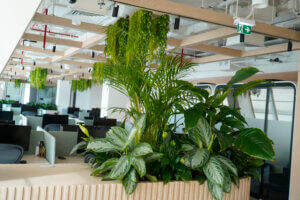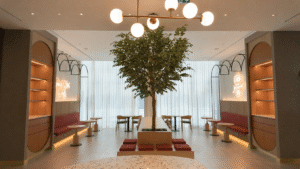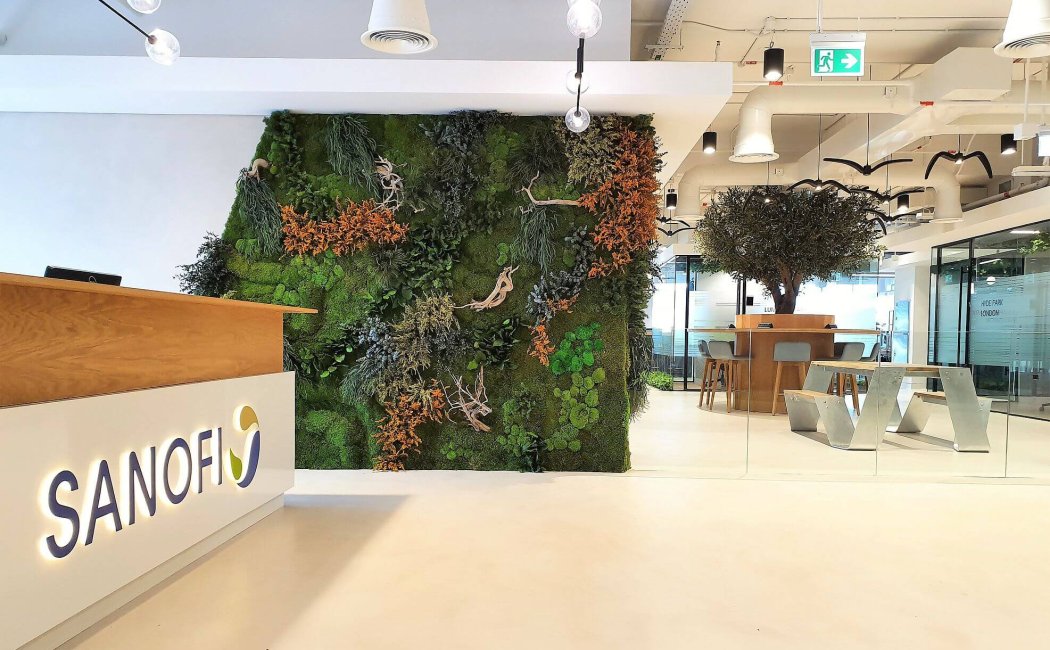
When a designer or facilities manager specifies a wall-based green feature for a UAE commercial space, one of the earliest decisions is whether to go with a living wall — a structure of planted, irrigated vegetation — or a preserved moss wall, where natural moss has been treated and stabilised to require no water or light.
Both are increasingly common in UAE commercial interiors. Both can look exceptional. But from a maintenance perspective, they are fundamentally different products — and understanding that difference is essential before making a specification decision that will affect the building’s operations for years.
Lorem ipsum dolor sit amet, consectetur adipiscing elit. Ut elit tellus, luctus nec ullamcorper mattis, pulvinar dapibus leo.
What Each Product Actually Is
A living wall — sometimes called a green wall or planted wall — is an active horticultural installation. Plants grow in a growing medium fixed to a wall structure and are kept alive through an automated irrigation system, often with supplementary grow lighting. The plants are living organisms that grow, change, and respond to their environment. They can decline, get pests, and need intervention when things go wrong.
A preserved moss wall uses natural moss that has been harvested and treated with a glycerin solution that replaces the water content in the plant cells, stabilising the moss permanently. The moss retains its natural texture, colour, and softness, but it is no longer alive — it does not grow, does not need water or light, and does not change over time. It is a fixed, static installation.
Maintenance Requirements: The Real Comparison
Living Walls
A living wall in the UAE is a high-maintenance installation. This is not a criticism — it is simply the nature of what the product is. Managing a living organism in an enclosed commercial environment, in a climate that creates significant environmental stress, requires consistent professional attention.
The maintenance programme for a UAE living wall typically includes:
- Weekly irrigation system checks — flow rates, blockages, timer calibration
- Regular plant health assessment and early pest intervention
- Fertilisation and nutrient management calibrated to season
- Plant replacement when sections decline — this is normal and should be budgeted for
- Pruning and shaping to maintain the designed appearance
- Seasonal adjustment of irrigation and care routines, particularly during UAE summer
A living wall without a professional maintenance contract in place will decline. Not over months — over weeks, particularly during summer. The investment in installation is significant; the maintenance programme is what protects it.


Preserved Moss Walls
Preserved moss walls are genuinely low-maintenance. This is one of their primary commercial advantages and the main reason they are specified in spaces where a living wall maintenance programme is not practical.
The maintenance requirements for a preserved moss wall are limited to:
- Regular dusting — the moss surface traps dust in the UAE environment and should be gently cleaned every month or two
- Visual inspection for any physical damage — panels can be dislodged in high-traffic areas
- Humidity monitoring — preserved moss performs best in environments with moderate humidity; very low humidity over extended periods can cause the moss to become brittle
- No irrigation, no fertilisation, no pest management, no plant replacement
A preserved moss wall does not require a professional maintenance contract in the way a living wall does. It requires periodic attention, but the operational burden is substantially lower.
The Trade-Offs
The maintenance difference between the two products comes with trade-offs that affect the specification decision.
A living wall is dynamic. The plants grow and change, which means the installation evolves over time — ideally becoming denser and more lush. It brings the qualities of a living ecosystem into the space: subtle movement, natural variation, the air quality and sensory benefits of genuine plant life. For spaces where these qualities are central to the design intent, the maintenance commitment is worthwhile.
A preserved moss wall is static. It will look the same in three years as it does on installation day — which is an advantage for consistency but means it lacks the dynamic quality of a living installation. The moss will not grow, will not change, and cannot respond to its environment. For spaces where maintenance simplicity and longevity of appearance are the priority, this is the right choice.
Where Each Works Best in UAE Commercial Interiors
The specification decision should be driven by the conditions and operational reality of the space, not just aesthetic preference.
Living walls work best when:
- The space has adequate natural or supplementary light for plant health
- MEP infrastructure supports an irrigation supply point
- A professional maintenance contract is budgeted and in place
- The dynamic, natural quality of live planting is central to the design brief
Preserved moss walls work best when:
- Light levels are inadequate for live planting
- Irrigation infrastructure is not feasible
- Maintenance access is limited or restricted
- Consistency of appearance over time is a higher priority than dynamic growth
- The client does not want or cannot support an ongoing professional maintenance programme
What This Means for the Specification Decision
The question of which is easier to maintain has a clear answer: a preserved moss wall requires significantly less maintenance than a living wall. But that is not always the right question. The right question is which product is right for this space, given its conditions, its design intent, and its operational reality.
In many UAE commercial projects, a hybrid approach is the most effective: living walls in zones with good light and maintenance access, moss walls in spaces where those conditions are not present. This allows the designer to use both products where each performs best, rather than defaulting to one or the other across an entire fit-out.
A specialist contractor who can honestly advise on both options — without a commercial incentive to push one over the other — will always produce a better long-term result than a provider who only sells one type of green wall installation.